


 |
Fine Bubble Diffusers Need to know more? Send us an email or feel free to search our online series with our give away search engine: |
 |
Diffused aeration systems are frequently classified into two major categories according to the diffuser's pore/bubble size, i.e.fine-pore diffusers and medium/coarse diffusers.
Medium/coarse diffused aeration systems are used in foul-prone applications.
Most types and brands are suitable for activated sludge applications, but each has its own best applications. The key is to size the unit properly for each application. Once OTR characteristics are established, the sizing is fairly straightforward. Other factors include alpha factor, impact of floc size and settleability, impact on effluent TSS, etc. The key phrase is "if properly sized/selected."
For conventional activated sludge of average rate, i.e. medium rate, it is generally recommended approximately 50 lbBOD/1,000 cu.ft. as maximum. For process stability and better assurances of performance, [fine pore/fine bubble] diffused aeration systems favor the use of low f/m and that is generally restricted to about 10-15 lbBOD/1,000 cu.ft. This significantly lower rate sizing tip takes into account process recommendations (extended aeration) as well as diffuser technology old hands recommendations.
Design of the aeration tanks is also important for optimum efficiency. Fine bubble diffusers can work at 2.5 water depth but deeper basins will give greater efficiency and superior results on capital costs. Diffusers are directly dependent on liquid depth for their aggregate efficiency. As a result, if the basin depth is doubled, it will approximayely use the same horsepower but it will take only roughly one-half the number of required diffusers, i.e. capital cost of the diffusers is about 50%. Using deeper basins, e.g. 5m, and larger volumes offer much better assurances of performance. It must be said that one of the authors once witnessed a probably still exisiting wastewater treatment plant at an edible oil plant having a detention time of ... [only] ten (10) minutes.
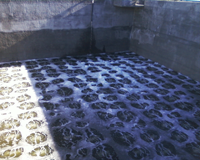 A common rule of thumb indicates the air volume required to mix a tank is 0.12 cfm of air per sq.ft. of flat floor area in the tank This is a way of showing or representing the actual energy requirements per square foot of tank floor. The reason the 0.12 cfm per square foot of tank is used is to eliminate the variable of depth from the calculation. Regardless of the depth of the tank one ends up with a proportional energy per unit volume. Using a value of 20-30 cfm of air per 1,000 cu.ft. as some engineers do, may be a disproportionate amount of energy requirement for deep tanks which may not be realistic. One must understand the 0.12 value as pertaining to biological solids only. If it were a tannery wastewater with a lot of heavy material or difficult solids, one could suggest the energy level for mixing be increased to 0.15 or possibly even approach 0.2 cfm per floor square foot. This is a determination based on the characteristics of the solids to be handled. For instance, for aerobic digesters one could/would specify0.2 to 0.3 cfm per square foot because of the high concentration of solids and more difficult mixing conditions.
Most types and brands are suitable for activated sludge applications, but each has its own best applications. The key is to size the unit properly for each application. Once OTR characteristics are established, the sizing is fairly straightforward. Other factors include alpha factor, impact of floc size and settleability, impact on effluent TSS, etc. The key phrase is "if properly sized/selected."
Mike Tate, P.E. Activated Sludge, Oxidation Ditches, SBRs and more
The focus of nanobubble technology has been on methods for generation of nanobubbles and much less on applications. There are now some who are trying to commercialize the technology, but it is not clear concerning applications where it will offer advantages. With regard to wastewater treatment applications, historically the oxygen transfer (aeration) system has played the dual role of providing mixing energy to suspend biomass in the process. Nanobubbles, of course, do not do this. Thus, for nanobubble technology as it is being developed the applications will not be for traditional oxygen transfer in wastewater treatment systems.
The reader should be reminded of WEF Manual of Practice FD-13 Aeration (p.033 Diffused Air Systems)as follows: while porous diffusers commonly produce 2 to 3 mm diameter bubbles "there seems , however, to be a limit to the effectiveness of decreasing bubble size. Barnhardt found that the overall gas transfer coefficient, KLa, increased while bubble size decreased until the bubble diameter approached 2.2mm; but, further reduction in bubble size resulted in decreasing KLa. Although smaller bubbles may increase OTE, the additional power required to offset the increased headloss across the diffuser may negate any potential saving."
While it is possible to use diffusers in production processes, i.e., pneumatic agitation or mixing, in our case we will refer exclusively to the most common applications in biological effluent treatment, e.g., BOD5 removal, nutrient removal, aerobic sludge digestion, polishing, aerated pretreatment in equalization tanks, among others.
Perhaps the most common application of diffusers, both tube and disc types, is in activated sludge processes and their variations. Generally, the goal is to maintain a population of microorganisms that consume the dissolved organic matter (approximately 0.45 µm in Whatman mesh). As with mechanical aeration, the required power (e.g., the amount of air, m³/h) for oxygenation must be calculated and compared to the power (amount of air, similarly) needed to prevent biomass settling in the reactor and achieve uniform mixing or distribution of the components.
To ensure uniformity of criteria, our recommended definition of " complete mixing " implies that the concentration of suspended solids does not vary by more than 10%, above or below, the average concentration at any point in the tank or lagoon, and that no significant deposition or settling occurs at the bottom of the reactor.
In most cases, an estimate of the air flow rate required for oxygenation (Vo) can be obtained from basic data (BOD5, TKN, temperature, operating depth). On the other hand, the amount of air needed to prevent biomass settling and allow for complete mixing (Vm) can be estimated by prescribing approximately 0.12–0.15 CFM per sq. ft. of bottom. In the case of aerobic sludge digesters, specifications on the order of 0.25–0.3 CFM per sq. ft . of tank bottom are common.
Since many times it involves the restoration of facilities where there are already existing tanks of a given geometry, we can distinguish three more or less "classic" contexts depending on these values:
If Vo = Vm we are lucky in the sense that we do not "waste" or "leave anything" and the selection process is quite straightforward;
If Vo >> Vm, there is little we can actually do, as there is no alternative but to deliver the oxygen that is needed; in a way, it would be important to consider the possibility of using a larger reactor to make better use of the air and simultaneously have a process with greater treatment capacity, e.g., instead of having one day of hydraulic retention, consider the alternative of two, or eventually three or more days, always with sludge return;
If Vo << Vm, a smaller reactor can be considered, or the air can be managed with what we could call an automatically controlled intercalation feed system.
Regarding design values, one can consider 8-10 CFM per meter of tubular diffuser and 1.3-1.5 CFM per 9" disc diffuser. These generic values are fairly well established in the industry and, while the final selection can be optimized, they can be used in preliminary designs.
In many cases, manufacturer information is proprietary. However, some manufacturers accept an AOR/SOR ratio between 0.33 and 0.38 in the absence of consulting data. A transfer efficiency of 1.7 to 2% per foot of submergence can also be assumed . Therefore, for an operating depth of 3.05 m (10 ft), the transfer efficiency would be between 17 and 20% under standard conditions.
All diffuser manufacturers acknowledge that membrane performance eventually declines significantly. While a lifespan of approximately 10 years is frequently mentioned, in our experience (still very satisfactory for our clients), we have seen the need to replace membranes before 5 years. It all depends on what needs to be minimized during the plant's construction. Perhaps part of the solution for achieving a very good experience with these units is to design the process with low volumetric loading rates. While in very well-controlled environments, values such as 50 lbBOD/day per 1000 cu.ft. are considered "average," a design school using diffused aeration systems might specify operating between 10 and 15 lbBOD/day per 1000 cu.ft. Even though the design might consider a long diffuser lifespan, perhaps more fundamentally, it aims for an extremely stable and flexible process, likely with a f/m ratio of 0.05–0.1 . Not only would we have better removal, but we would also have less and better excess sludge in terms of its tendency to settle.
An important aspect regarding equipment minimization is the operating depth of the diffusers. Generally speaking, an installation with twice the operating depth of another will require approximately half the investment in the components to be installed in the tank. However, the BHP (boiler horsepower) remains stable because what is gained in heat transfer is offset by the loss in head loss.
In any case, let's remember the recommended safety margins: any value between 1.3 and 1.5 .
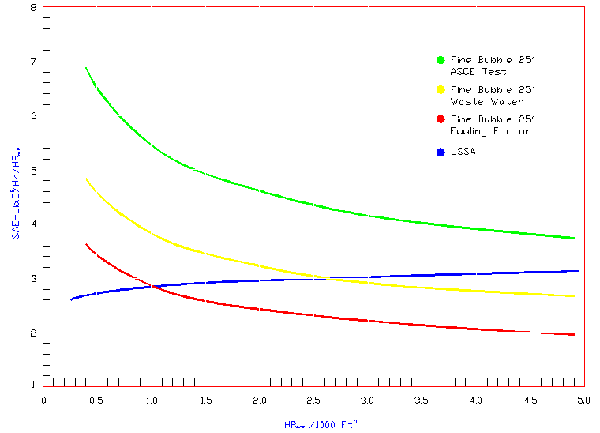
Comparing aeration technologies simply by using performance values in clean water is not appropriate or representative/a good predictor of the performance of the equipment in service.
Sample keywords: hydrogen sulfide EGSB tannery (no commas!)
