


 |
Trickling Filters An OnLine Primer Need to know more? Send us an email or feel free to search our online series with our give away search engine: |
 |
With the impressive advancement of anaerobic treatment alternatives, whether high or low rate, specifying biotowers in industrial wastewater treatment systems has become a little bit of the past.
Also noteworthy is the limited knowledge available for sizing biotowers in industrial settings, so the existing shortcomings in this area, even considering municipal effluents, make the disadvantage even greater, calcs are hydraulics and mostly rules of thumb on loading.
Let's look at an example of this argument. While in the past this approach has resulted in facilities with excellent COD removal rates (96%), with the current limited information, it would likely be a clear step in favor of anaerobic pretreatment.
Say we're asked to provide a pretreatment biotower for a planned small pharmaceutical wwtp, rough specs being as follows:
max daily flow = 300 m3/day
BOD5 = 9,000 mg/L (COD possible three times this value)
ammonia nitrogen = 65 mg/L
winter temperature = 18°C
summer temperature = 25°C
First red flag: consulting engineer is providing only BOD5, enough reason to dismiss the request.
Let's move forward notwithstanding.
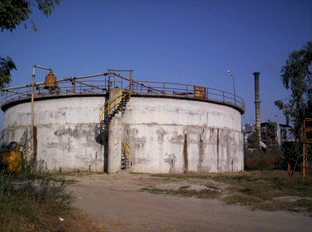
Say we're able to get away with a 50 lbBOD/day per 1,000 cu.ft. design, which gives a ca. 3,320 m3 biotower, 23m dia., about 8m media depth and considerable recycling.
Perhaps one could consider a low rate fermenter sized for a guesstimated COD = 30,000 mg/L (about thrice reported BOD5 given), 1 kgCOD/day per m3 giving rise to a 9,000 m3 system or 30 day detention, aiming at anywhere from 65 to 80% COD removal and say 90% BOD removal. Treatability study almost mandatory but unequivocally enlightening.
Feel free to play with numbers (Enter your numbers but check your Yo's and Kd's as well!)
https://engineeringfundamentals.com/jcy.html
Sample keywords: hydrogen sulfide EGSB tannery (no commas!)