


 |
Bioremediation Fundamentals Need to know more? Send us an email or feel free to search our online series with our give away search engine: |
 |
Let's calculate an estimate of the required solids retention time for a small petroleum refinery stream containing benzene (1850 ppm -> COD = 1850* 3.08 = 5700 mg/L). Please be aware that these calculations are a simplification of the actual project data. For example, actual solids inventories could be smaller or larger and all other derived magnitudes adjusted accordingly. SRT is thus about ballpark.
| SRT Sludge Age Sizer | ||||||||||||
| T | 25 | °C | ||||||||||
| Yoc | 0.5 | Petroleum Refinery Stream | ||||||||||
| Kd | 0.250 | (also called b) | Stream containing about 1850 ppm benzene | |||||||||
| Carbonaceous Removal Sludge Age | ||||||||||||
| flow in | 240 | m3/d | 0.063 | mgd | ||||||||
| CODin | 5700 | mg/L | 3011 | lbCOD/day | 1366 | kgCOD/day | applied | |||||
| 0 | kgCOD/day | via denitrif | ||||||||||
| 1366 | ||||||||||||
| Percent | 100 | % Treated | 1366 | kgCOD/day | ||||||||
| Percent | 98 | % COD removed | ||||||||||
| Vreactor | 190440 | gallon | 721 | m3 | (from order of magnitude sizing) | |||||||
| 0.19044 | mg | 1.89 | kg applied COD/day per m3 | (Residual OK) | ||||||||
| Target MLVSS | 1.89 | kg applied + from denitri COD d/m3 | ||||||||||
| 5320 | mg/L | 8439.463 | lb bugs | 3828 | kg bugs | total bugs in tank but say only | 100.0 | % heterotrophs | ||||
| 5320 | mg/L | 8439.463 | lb bugs | 3828 | kg bugs | (heterotrophic biomass) | ||||||
| SRT | 20.04 | days | (iterates automatically) | |||||||||
| Ync | 0.143 | ok | f/m | 0.357 | kg AppliedCOD d per total kg bugs (Residual OK) | |||||||
| f/m | 0.357 | kg Applied + From Dentir / total kg bugs | ||||||||||
| biomass yield = | 191 | kg/day bugs | due to appliedCOD | |||||||||
| HRT = V / Q = | 3.0 | days | ||||||||||
| 72 | hours | ok | ||||||||||
Sample Assignment: Select suitable aeration equipment for a 50m * 50m * 2.5m basin to be used for a slurry-phase bioremediation treatment.
Consulting engineer provided a basic SARA (Saturates, Aromatics, Resins and Asphaltenes) analysis, a chemical characterization method used in the petroleum industry to fractionate heavy crude oilsIt separates the sample into four main groups based on solubility and polarity, essential for optimizing refining, assessing crude quality, and predicting colloidal stability. 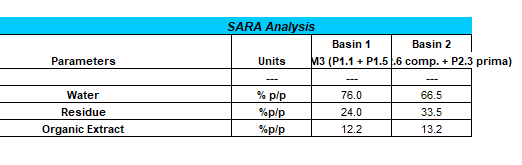
It's not that easy to settle on a given MLSS typical of wastewater projects, as well as most other parameters. Annotations from archives:
Power densities range from 20 to 50 kW per 1,000 m3 for moderately thick suspensions and 100 to 250 kW per 1,000 m3 for thick suspensions. Operation is typically batch. Solids content of between 5 and 20 percent is typical (US EPA, 1993) - still solids content can range between 10 and 40 percent. Dissolved oyxgen 2 mg/L desirable.
Preliminary setting and selection was as follows:
Basin dimensions: 50m x 50m x 2.5m water level
8-10% slurry
four (4) 150 HP high speed surface aerators
four (4) 15 HP submersible mixers
System was to operate for about twelve (12) months.
Feel free to work out the proposed power density and compare with regular wwtp values. Rationale behind not that oxygen requirement were that large but the need to sustain mixing throughout said period.
Sample keywords: hydrogen sulfide EGSB tannery (no commas!)
