


 |
Bioremediation Fundamentals Need to know more? Send us an email or feel free to search our online series with our give away search engine: |
 |
Reference 1 provides a very good working definition for bioremediation, i.e. the term is applied to any system or process in which biological methods are used to transform or immobilize contaminants in soil or groundwater.
The agents responsible for breaking down organic chemical contaminants can be bacteria, fungi and/or enzymes. In order for these microorganisms to carry out their cycle, some livable environment conditions must be met, e.g. temperature, oxygen availability, pH. Also nutrients, such as nitrogen and phosphorus, must be available.
Because of this need of a proper context, there are several factors beyond pure biological processes. These factors, which influence the effectiveness of bioremediation, are roughly grouped in three major categories, i.e.
The common objective of the various systems is the conversion or transformation of polluting compounds into water, carbon dioxide (CO2), or other inorganic gases or substances, and cellular mass. In other words, to provide or ensure an 'artificial' environment to replicate phenomena that occur in nature. Therefore, all the "classic" concepts of biological degradation or digestion are applicable, as can be found, for example, in fundamental university texts (3). In certain cases, this working definition may include or consist of the immobilization of the pollutant. Fortunately, most petroleum derivatives are relatively easy to degrade and therefore reasonably amenable to being addressed by the various bioremediation alternatives (1).
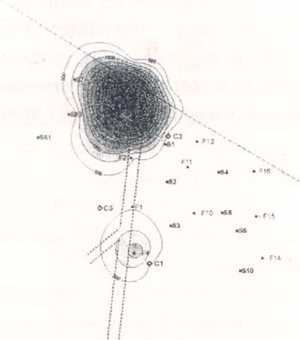
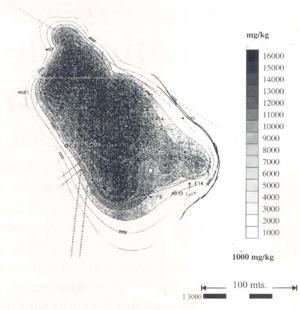 As an illustration of what is "happening in the real world," the two accompanying figures show a map of a pollution instance, indicating the distribution of concentrations at the surface and at approximately 50 cm depth. Unfortunately, it is not always possible to obtain such a specific 'x-ray' of the problem, in many cases because the problem lies at significantly greater depths, in other cases because the affected area is not practicable or accessible (under buildings), and in many cases, because there is simply no minimum infrastructure available to carry out the task.
In this specific case, the chosen treatment would likely be the removal of the contaminated material for subsequent composting , either in specially prepared areas of relatively large size but with low energy requirements, or alternatively, in biocomposters —closed systems that are relatively energy-intensive and selective in their applications due to the also relatively significant initial capital investment. These latter systems (closed systems), however, allow for markedly greater process control (cycles of approximately 20–26 days), since they can utilize, for example, auxiliary devices to promote better contact and uniform distribution ("blending") between microorganisms, air/oxygen, nutrients, and the target contaminant or constituent.
Because these systems are not exposed to the elements, heat dissipation is minimized, and temperature and oxygenation control can be achieved through forced ventilation. On the other hand, the closed nature of these systems allows for optimal emissions control (typically supplemented with smaller biofilters than other alternatives) as well as the elimination of leachate from the plant site, surrounding areas, and groundwater.
With increasing regulatory pressure, these last two factors are far from negligible when assessing the problem holistically. These systems are particularly recommended for treating, for example, sludge from settling or flotation cells at refineries and/or terminals located in densely populated urban areas or areas with extremely limited available land for a treatment plant.
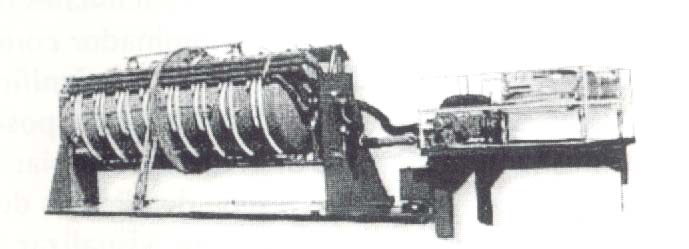
Fig. 3 Biocomposter (courtesy of DBS Manufacturing)
In-Situ vs. Ex-Situ Treatments
As the name suggests, the treatment of the contaminated mass can be attempted in situ , i.e., without excavation and/or transport, or ex situ , typically by removing the contaminated material and proceeding with its treatment in tanks or specially suitable areas. Very briefly, in-situ treatments(1, 4, 12, 13, 14) aim to degrade the contaminant on-site, with several possible alternatives, dictated somewhat by the amount of material affected, the depths involved, and/or other constraints, e.g., resource availability, the time frame in which the problem must be resolved, the limit values that must be achieved, and the characteristics of the terrain, e.g., clayey, porous, or with fractures.
The techniques chosen may vary, for example, if the contaminant resides in an unsaturated zone ("vadose zone") or if the problem already affects aquifer/groundwater zones. In very basic terms, the various procedures focus on maintaining optimal conditions for the growth of microorganisms: adequate oxygen levels, appropriate moisture content, a balanced nutrient mix, and any necessary biodegradation promoters. Thus, oxygen supply, for example, can be achieved through forced airflow (using blowers) or induced airflow (using vacuum pumps); or by injecting or percolating solutions containing NO3 or H2O2.
Some of the considerations for in situ treatments also apply to ex situ treatments (1, 4, 12, 14), which, as we mentioned, consist of relocating the material (with associated costs and risks involved in transportation!) and subsequently treating it in specially suitable areas or containers. For example, we could consider treating the contaminated mass in batch or semi-batch biological reactors (SBRs), a type of liquid phase ("slurry phase"), in tanks or basins similar to those found in municipal treatment plants (1, 4, 12).
Compared to other treatment alternatives, this system, in which treatment occurs under saturated conditions (the contaminant or constituent material is kept in suspension in an aqueous medium), generally allows for maximum contact between the constituents: contaminant, biomass, oxygen, water, and nutrients. Depending on the specific definition, in certain instances this alternative ("slurry phase") can be carried out in situ. In any case, what we want to recognize here is that this is the familiar biological treatment, implementable with, for example, diffuse aeration systems or surface units, in which, as in municipal and industrial effluent systems, we must simultaneously supply and distribute oxygen, achieve good mixing levels (e.g., max. +/- 10% discrepancy in SS at any point), and keep the biomass in suspension to successfully carry out the treatment. The contaminant will be present both dissolved (< c. 0.45 µm) and adhered to surfaces and solids.
Depending on the reaction kinetics, slow or fast, different mass balances must be considered for the liquid phase and for the adhered phase (1). For example, 3 g of oxygen could be allocated for every g of diesel, and the usual calculations for sizing aeration systems could be applied. Obviously in these cases the calculation of the brake horsepower for mixing must be done more carefully, as we can have a solids content typically between 5 and 20%, and even up to 50%, therefore it is important to consider the specific design recommendations (1).
Various ex situ solid-phase treatment alternatives include land treatment and composting , with the aeration method being the distinguishing factor. Land treatment procedures (1, 4, 5), inspired by centuries-old agricultural practices, basically consist of applying and distributing the contaminated material in specially confined areas (prepared with bottom liners, drainage and monitoring systems, liquid storage, among others) and integrating it into the soil matrix by supplying air using similar equipment employed in production: tractors, plows. Treatment can also be carried out in situ or using specially prepared areas such as abandoned plant parking lots. While the benefits include low initial capital requirements and operating costs, they necessarily involve large areas that are not always available and frequently result in high volatilization rates, which may or may not be acceptable depending on applicable and/or current criteria. Additionally, they are only immediately applicable to contamination at depths achievable with conventional agricultural implements (between 15 and 50 cm).
Composting alternatives (1, 4, 5, 6, 15, 27, 29) can include long, tall (e.g., 5 m) open-air composting systems, as well as treatments in specially equipped enclosures (Fig. 5) or closed containers. In biopile systems, oxygen can be supplied mechanically by redistributing the material in the piles ("windrows"), or passively by injecting air through perforated pipes ("static piles"). Compared to the previous treatment system (land treatment), composting plants require considerably less land area. The process yields biologically stable products (e.g., humus), which, while not strictly fertilizers, are useful for production processes, such as soil conditioner or amendment. Similar to land treatment, open-air composting has low energy requirements. Although emissions issues may arise, it is a significantly cheaper and much simpler alternative to indiscriminate incineration. Depending on the chosen option, maintenance may be significant or not. Finally, the alternatives of biocomposters or closed systems have already been discussed .
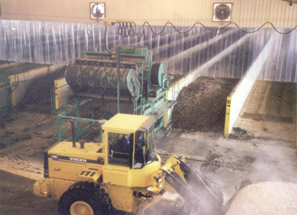
Fig. 5 Mechanized composting lines (courtesy of US Filter)
Regarding composting alternatives in general and their promising potential (27), the comments by Savage et al. (15) within the context of hazardous waste management and treatment are extremely interesting: "Despite its limitations, the composting system is currently competitive with incineration and/or landfill alternatives as a means of disposing of waste resulting from agricultural activities, contaminated municipal solids, and petroleum refinery sludge. Furthermore, it is [highly] likely to continue maintaining its competitive position. This forecast is explained when one compares the inherent advantages and disadvantages of composting systems with the characteristics of alternative physical, chemical, and thermal methods (e.g., incineration, landfills).
The same [economic] criteria that favored the expansion of municipal sludge application systems and the corresponding decline in incineration argue in favor of composting systems for [hazardous] agricultural waste and petroleum sludge. The dimensions of the problem, the characteristic factor of agricultural waste, This makes composting economically more attractive than disposal using incineration. The costs and difficulties involved in attempts to incinerate petroleum sludge have led to the search for alternatives to incineration. The success experienced in treating these sludges by landfarming and the results obtained in petroleum sludge composting research point to biological composting systems as an attractive alternative.
In many cases, even when a high degree of biodegradation has been achieved, biological processing of contaminants carried in air streams may be required as a result of a certain percentage of volatilization (e.g., intentional volatilization with the SVE system, i.e., "soil vapor extraction"; an undesirable fraction in the case of a biological treatment implementation). In such cases, gas-phase biological treatments using biofilters or biotrickling filters, similar to trickling filters, may be applicable. As with the latter, the treatment of the contaminant is carried out by the formation of biomass films that develop inside the towers (1, 4, 17), with synthetic supports (e.g., random or structured packing) as well as compost and other materials being acceptable. In the case of biofilters, the constituent/contaminant initially resides in the gaseous phase and then dissolves to be assimilated by the microorganisms, whereas in conventional trickler filters, the contaminant is mostly already dissolved in the liquid to be treated.
Unfortunately, in many instances, contamination is not limited to relatively superficial or confined areas. In many situations, the contaminant is present in natural reservoirs, aquifers, which frequently supply water for human consumption. For populations where the drinking water supply comes from groundwater, as opposed to surface water, this presents a very serious and difficult problem to solve. What we will briefly discuss below is water remediation, not water purification or recovery.
Among the alternatives for groundwater remediation (1, 4, 5, 12), we can mention the pumping, treatment, and reinjection sequence, and, on the other hand, aeration of the water body. The pump-treat- reinject
(PTR) alternative (a combination of ex-situ and in-situ treatment) involves pumping liquid from the contaminated aquifer, then treating it using conventional treatment plants, a sewage system, or other disposal methods, and potentially adding oxygen and nutrients if it is returned to the aquifer to promote in-situ remediation. Air sparging alternatives , similar to conventional biological treatment, involve the forced or induced introduction of air to maintain an adequate level of dissolved oxygen for biological activity. In simplified terms, this can be achieved by injecting air into the aquifer using blowers.
Among the alternatives for the treatment of unsaturated zones (1, 4, 5, 12, 16), we can highlight:
- induced volatilization and subsequent treatment of the air stream (SVE or "soil vapor extraction"), in the case of volatile contaminants; in this case it can lead to a subsequent biological treatment of the contaminant in gas phase, for example, through the use of biofilters or biotrickling filters; - biodegradation in place by supplying air to the unsaturated zone in order to promote in situ degradation, in the case of less volatile contaminants ("bioventing").
Part of what makes bioremediation problems unique is the characteristic distribution of contaminants. In the case of conventional wastewater and industrial effluent treatments, even in refineries and terminals, the contaminant is typically "accessible" in the flow to be treated. In these now common cases, we often attempt to successively separate the contaminant by gravity (settleable mass, e.g., API tanks in refinery effluent treatment plants) and/or flotation in DAF units prior to the biological process. (Once the emulsion is "broken," and the pressurized liquid is released, air bubbles carry the contaminant along like a kind of elevator, based on Henry's law for gases of low solubility.) Depending on the specific case, we would then need to process the dissolved contaminant (let's say arbitrarily < 0.45 µm), for example, using diffuse aeration systems. This treatment train has the same standard unit processes found in conventional effluent treatment plants.
Sample keywords: hydrogen sulfide EGSB tannery (no commas!)
