








 |
Dewatering Fundamentals |
 |
CASE STUDIES
Best way to warm up and remember Dr. Ray Regan and his CE370/CE297 picking two assignments from Hammer's textbook. Jim, at one time program chairman, wrote the accompanying notes for the course and Tom Irwin, Jim's lab manager proctored my examination. Tom was at one time at Great Valley. Kinda Penn State outpost!
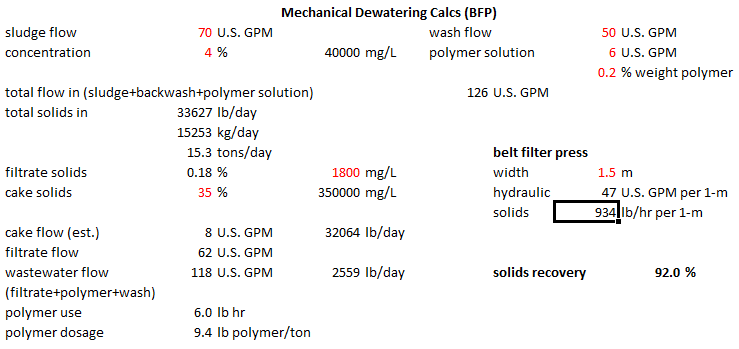
EXAMPLE # 1 - ANAEROBIC DIGESTER SLUDGE
Sludge from an anaerobic digester is fed into a 1.5m wide belt filter press. The feed rate is 70 gpm. The polymer dosage is 6 gpm, containing 0.20% polymer by weight, and the wash water usage is 50 gpm. Laboratory analysis/test results indicate 4% total solids at the inlet, a total solids concentration close to 35% at the outlet, and suspended solids in the discharge (supernatant, solution, and wash water) on the order of 1,800 mg/L. Determine: 1a. hydraulic feed rate, 1b. solids loading rate, 1c. polymer dosage, and 1d. percentage of capture or recovery.
EXAMPLE # 2 - ANAEROBIC DIGESTER SLUDGE
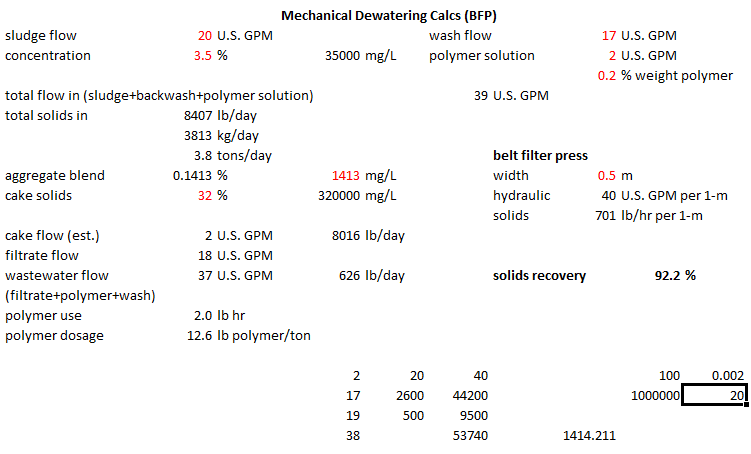
A belt filter press unit installed on a mobile platform was used to evaluate the dewaterability of digested anaerobic sludge. The effective width of the unit is 1.5 m. The data from the in-situ and laboratory pilot test yielded the following values:
feed flow rate: 20 gpm
polymer dosage 2.0 gpm 0.20% polymer by weight
wash water: 17 gpm
Total solids in the feed: 3.5%
Solids by mass concentrated: 32.0%
Content of belt wash return 2,600 mg/L SS
supernatant/filtrate flow rate 19 gpm and 500 mg/L SS.
Required information: hydraulic load, solids load, polymer dosage per ton of dry solids processed, and capture/recovery percentage.
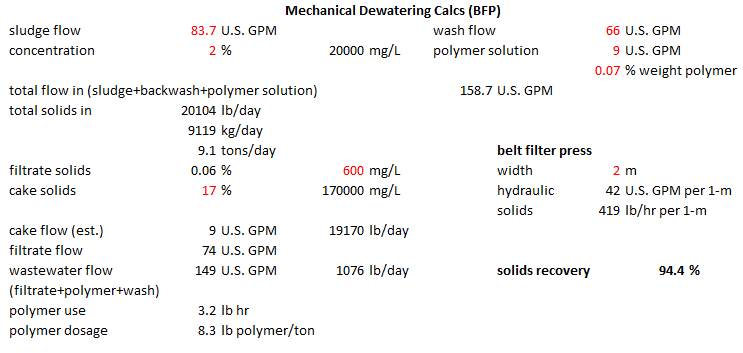
EXAMPLE # 3 - BIOLOGICAL SLUDGE FROM EXTENDED AERATION WWTP
Use of a belt filter press in an extended-type treatment plant.
EXAMPLE # 4 - WATER TREATMENT PLANT ALUM SLUDGE
A surface water (river) treatment plant must coagulate raw water with a turbidity level of 9 units using a dosage of aluminum sulfate ("alum") at a rate of 30 mg/L. Estimate the amount of sludge generated, expressed in pounds per million gallons of processed liquid. If possible, include representative examples of this type of application.
The main constituents of coagulation, e.g., iron oxide and aluminum hydroxide, vary depending on the coagulant used. Even though the use of common chemical formulas and reactions is "accepted," studies show that the hydrolysis of aluminum and iron salts is much more complex than these formulas indicate, and they don't even accurately represent what occurs in water. Nevertheless, they have been considered useful for obtaining approximations regarding the products of the different reactions and quantitative relationships.
In addition to the precipitation products mentioned, small amounts of activated carbon and various additives to promote coagulation, such as polyelectrolytes and activated silica, may also be present. The particulate matter present in the floc is primarily inorganic, including, for example, clays.
Given the very low organic content, significant biological activity is not expected. The aluminum hydroxide produced has a gelatinous consistency, which makes dehydration difficult. The concentrations obtained in the settled solution range from 0.2 to 2% for aluminum, being slightly denser when dealing with iron precipitates.
For the coagulation of surface water using aluminum sulfate, the total solids produced, expressed in pounds per million gallons of processed liquid, as a function of the aluminum dosage (mg/L) and raw water turbidity units, is given by the formula:
lb/mg = 8.34 * (aluminum dosage in mg/L * 0.25 + turbidity units).
In our case: turbidity 9 units, Al dosage 30 mg/L.
Evaluating this expression, we get: lb/mg = 137.61 lb/mg.
Assuming that the filter retains 30% of total solids, we get
pounds of sludge per mg of processed liquid = 96.327 lb/mg.
Finally, assuming for illustrative purposes that the percentage of solids is 1% (range 0.2 - 2%), we obtain the following sludge flow rate for dewatering per mg of processed liquid:
1156 gallons of sludge per mg of liquid to be processed. of gallons of processed river water
Final note: as a reference, contemporary design equipment would present the following operating context:
feed 2% solids concentration
output between 22 and 30%
capture percentage, minimum: 90%, expected: greater than 95%
maximum polymer dosage: 4 kg per ton of dry residue;
expected: between 1 and 2 kg/ton of 0.37% formulation