








 |
Dewatering Fundamentals |
 |
FUNDAMENTALS
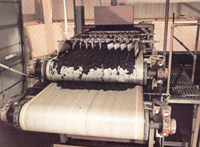 The decision to differentiate between thickening and dewatering , as defined by the Water Environment Federation guidelines, while somewhat arbitrary, establishes a reasonable distinction between the two terms. To clarify, we can consider thickening as having a solids content ranging from, for example, 0.7% to 2%, and reserving the term dewatering for processes resulting in a solids content of 15% or more. As an example, we can visualize gravity thickeners or table belt thickeners for thickening, and belt filters or filter presses, among others, for dewatering. Perhaps the predominant criterion for selecting the dewatering alternative in a given case is the evaluation of the subsequent processes involved in the circuit, as well as the final destination or disposal of the sludge, such as landfill, composting, direct application, or incineration.
SLUDGE TYPES
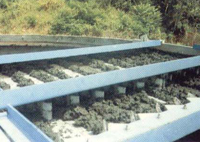
The first fundamental step in evaluating treatment alternatives is to identify the characteristics of the sludge to be processed. We can group most possible instances in the treatment plant into three main categories:
- sludge from physical separation (gravity) in primary clarifiers, where settling and consolidation occur at the bottom of the tank. We call the sludge generated in this way primary sludge.
- biological sludge : although settled by gravity, the characteristics of the sludge are such that its behavior or dewaterability is notably different from the previous case; in the case of trickling filters, we find fragments of biomass or humus; in the case of activated sludge plants, we have waste sludge (WAS);
- the third type of sludge can originate from chemical processes , such as when aluminum is used for phosphate removal, in which case the resulting sludge contains aluminum oxides, aluminum phosphate, and other precipitates, commonly known as "alum sludge."
Due to the markedly different behaviors of sludge during dewatering depending on its nature, it is crucial to correctly identify each instance. Thus, without intending to create preconceptions, biological sludge is notably difficult to dewater, while digested sludge from primary settling allows for easier concentration.
It is important to note that even with the same type of sludge, its behavior during dewatering varies depending on how it has been previously treated. For example, sludge from digestion that has been cooled does not dewater as easily as the same sludge at warm or lukewarm temperatures. Similarly, sludge that has been subjected to prolonged aeration may exhibit problems with its behavior during dewatering.
DEWATERING ALTERNATIVES
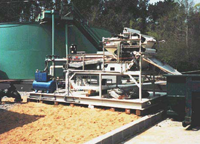
Broadly speaking, we can distinguish between natural dehydration alternatives, such as drying beds, or decidedly mechanistic approaches, such as filter press units or belt filter presses .
NATURAL DEWATERING ALTERNATIVES: DRYING BEDS
Drying beds have been used for many years, and when properly designed and operated, they are less sensitive to the concentration of incoming solids and can achieve higher concentrations than any mechanical device. While primarily used in small plants and areas with high solar radiation, they have been successfully employed in plants of all sizes and geographic locations.
Among their advantages are:
relatively low capital cost if space is available
; minimal need for operator intervention and training
; low energy consumption
; low sensitivity to sludge variability
; low consumption of chemical additives
; and high concentration levels.
Among its disadvantages , we note that
: there is no rational design method
; a large area of land may be required
; pre-digestion may be necessary; there is a high dependence on climatic changes
; there are potential institutional problems
; and there are significant labor requirements for removal.
During the 1960s and 1970s, drying beds lost some favor due to uncontrollable or unpredictable factors, such as variations in precipitation, temperature, and drainage rates. Compared to mechanical dewatering, drying beds can require large areas and a significant number of operators, an aspect not favored by contemporary industrial policies. Nevertheless, considering the significant investments that mechanical equipment may require, it is advisable to formally review this alternative.
The two most important dewatering mechanisms in the drying process on sand beds are the drainage stage and the evaporation stage . The drainage stage is actually subdivided into two parts. Initially, the water present is drained through the mud, the sand bed, and into the drainage channels . This stage, which normally lasts a few days, continues until the sand surface is saturated or all the liquid has drained. If a supernatant forms due to silting of the bed, it is removed /decanted.This stage can be especially important for simultaneously removing rainwater runoff, as otherwise the drying process would be slowed. Finally, the remaining liquid after the drainage and removal/decanting stages is eliminated through evaporation .
DEWATERING BY FILTER PRESS
During the mid-1800s, rudimentary filter press variants were successfully employed in the United Kingdom for sludge treatment, both with and without chemical conditioning. By 1908, a British Royal Commission register indicated the existence of 21 treatment plants with filter press units. All but four employed some form of chemical aid. Similar precedents exist in other countries, such as Germany and the United States, and remarkably, from their introduction until 1960, their basic features remained virtually unchanged.
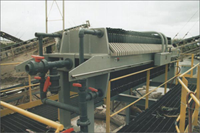 Filter presses did not actually gain widespread acceptance or use before 1970, partly due to the large amount of labor required for operation. Since then, the filter press has essentially evolved from a labor-intensive batch process to a partially automated operation in most cases. Improvements in machine design and automation controls, such as automatic plate exchange/repositioning, concentrate discharge, and washing stages, have considerably reduced the difficulties. On the other hand, the capacity of the units has increased considerably, so that even the largest plants often require fewer units, achieving reasonable feasibility in many cases. However, there are fully automated variable-volume filter press plants, such as the one in St. Paul, Minnesota—eight presses with 44 plates each.
In terms of both capital and operating costs, the filter press system still generally remains more cost-effective than other alternatives, but when disposal regulations have established strict concentrate values, the filter press has often proven its feasibility. Furthermore, many landfills have tightened their intake requirements in many areas of the US, with solids requirements of around 35% not uncommon. Likewise, in cases where incineration has been the only option for final disposal due to a lack of alternatives, filter press units have demonstrated their viability. Due to the higher percentage of dry solid residues in the concentrate (which increases the proportion of volatile material content relative to moisture content), autogenous combustion is possible, reducing the need to use supplementary fuels such as natural gas or fuel oil #2.
BASIC THEORY OF DEWATERING BY FILTER PRESS
Pressure filtration is the separation of suspended solids from sludge or mud by establishing a pressure differential as a driving force. Filtration processes can be classified as constant-rate or constant-pressure.
In constant-rate filtration , the flow rate remains constant, allowing the pressure drop across the concentrate to increase continuously during the cycle until the maximum permissible pumping pressure is reached.
In constant-pressure filtration , the pressure drop remains constant while the filtration rate declines continuously due to the accumulation of retained solids. The cycle ends when the filtration rate falls below a predetermined value.
In reality, due to the boundary conditions imposed by different types of equipment, as well as the complex and often unpredictable interrelationship of process variables, the dewatering process using a filter press does not fit neatly into either category unless we break down the idealized process into successive stages. We can then model the operation of the filter press as a combination of constant-rate and constant-pressure processes. We can say that the process begins with constant filtration rate characteristics up to the maximum pumping value and then transitions to a constant-pressure filtration regime until the rate drops below a predetermined value. In reality, the filtration cycle is characterized by temporary oscillations in flow rate, pressure, and solids loading. Design/project and process control decisions will help define the operating conditions, establishing the maximum operating value of the system (e.g., 100 psi) and the maximum and minimum feed flow rates.
It is common to distinguish, within the complete unit cycle, the so-called forming cycle , during which the filter feed occurs and which is frequently denoted as Thetac. During this feeding period, filtration resistance is low and the filtration rate is more or less constant until, due to the accumulation of solids in the porosity of the plates, the inner chambers of the plates begin to fill. In this last phase, we will have a filtration rate that gradually declines at constant pressure until the significant change in the porosity of the formed walls progressively inhibits passage, resulting in a decreasing flow and an increase in system pressure until it reaches the maximum admissible value that will be maintained until the end of the cycle.
TYPES OF FILTER PRESS UNITS
There are basically two types of filter presses commonly used for municipal sludge dewatering: constant volume (the most common) and the alternative variable volume or diaphragm filter press.
The constant volume filter press consists of a number of plates or trays housed within a frame to ensure proper alignment. These plates are clamped hydraulically or electromechanically at one fixed end and one movable end. Each plate has a drainage surface, a filtrate discharge channel, and a centralized feed inlet. The filter cloths covering the drainage surfaces provide the filtration element. A closing device maintains pressure on the plates while the filter is fed at pressure levels of approximately 700 to 1600 kPa (100 to 225 psig). The filter cloths capture suspended solids and allow the filtrate to drain through the channels. The solids accumulation cycle ends when the solids content reaches approximately one-fifteenth to one-twentieth of the initial value. At that point, the feed stops, the plates are repositioned, and the concentrates are discharged.
Variable volume filter presses , also called diaphragm filter presses, include an additional flexible membrane over the plates. The first stage of the variable volume unit's pressing cycle is identical to that of a conventional filter press. However, once the spaces between the plates are filled with liquid and concentrate formation has begun, the membranes are pressurized by compressed air or hydraulically (to approximately 1500–2000 kPa, or approximately 220–285 psi), further compressing the concentrate. This additional pressing stage accelerates the filtration rate and shortens the cycle time, resulting in higher concentrations with greater flexibility. The variable volume filter press differs significantly from the constant volume filter press in that it has a lower volumetric capacity, produces finer filtrates, and is highly automatable.
DEWATERING BY BELT FILTER PRESS (BFP)
Belt filter presses, also frequently called belt filters, consist of one or two special belts or tapes that allow for the continuous dewatering of sludge through a combination of gravity drainage and compressive forces. The first belt filter presses were developed by Klein in Europe and by Smith & Loveless in the USA around 1960. While they were successfully used in Central Europe approximately 15 or 20 years ago, and have a relatively contemporary appearance, a modern belt filter press design bears a striking resemblance to the paper machine invented by the Frenchman Fourdrinier in 1799, which could increase the concentration of solids from 0.5% in the inlet to concentrations exceeding 20%.
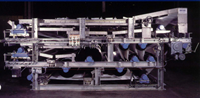
Belt filter presses have been so well received in Europe that they have practically replaced all other mechanical dewatering methods. In the mid-1970s, the units were being incorporated into the US market mainly because of their ability to successfully dehydrate the "problematic" biological sludge (decanted from the secondary clarifier), and their significantly lower energy consumption (e.g., 7.5 HP vs. 100 HP) compared to other units such as centrifugal and vacuum types.
BASIC THEORY OF DEWATERING BY MEANS OF A BELT FILTER PRESS
Belt filter presses dewater sludge through the combined action of drainage (simple gravity) and mechanical forces, i.e., compression. As with vacuum filtration, the dewatering process in a belt filter press is explained by applying D'Arcy's Law.
The dewatering process in a belt filter press is classically divided into three distinct stages of operation:
1. preparation and/or conditioning of the sludge by adding chemical agents;
2. drainage stage, primarily by gravity, until a non-flowable consistency is reached, carried out in the gravity separation zone, generally between 2 and 4 meters long;
3. the actual pressing or compaction stage using the belt system. Thus, the relatively dilute sludge, say on the order of 2-4%, after conditioning by adding polymers, drains a large percentage of liquid in the drainage zone.
At the end of the drainage stage, which typically lasts between 1 and 2 minutes, and depending on the solids content of the feed, approximately 50% of the liquid may have been removed, leaving solids concentrations between 6 and 10%. The third phase begins as soon as stress is applied, either by compressing the sludge between the two belts or by applying a vacuum to the underside of the conveyor belt. The working pressure can be adjusted considerably. However, any attempt to achieve a few more concentration points by arbitrarily tensioning the belts will substantially reduce their lifespan.
DESIGN AND SELECTION CONSIDERATIONS
In general, the selection criteria, or equivalently, the expression of the processing capacity or "throughput" of a given belt filter press, can be considered from a hydraulic point of view, or alternatively, from the perspective of permissible solids loading. Generally speaking, the latter is the most appropriate. Given a specific width of the unit, a certain maximum operating flow rate (e.g., gpm; m³/h) will be obtained, as well as a maximum solids loading rate (e.g., lb/hr; kg/h) that will only be achievable through proper pre-conditioning of the sludge. Thus, preliminary specifications may detail nominal values such as 40-60 US gpm per meter of belt filter press, even though some installations may achieve significantly higher values, e.g., 200%. Similarly, a dry residue of 1,000 lb/hr may be specified. Practical experience and the majority of manufacturers (with varying degrees of agreement or adherence regarding achievable percentages!) confirm that both the dewatering capacity and the associated concentrate percentage increase directly with the percentage of solids in the sludge being dewatered.
As with the other units, and with some discrepancies even among manufacturers, yields can also differ depending on the characteristics of the sludge being dewatered. Just as it is generally recognized that anaerobically digested sludge from a primary clarifier is more easily dewatered than aerobically digested biological sludge, the behavior of mixtures increases their dewaterability and the associated concentration level in direct proportion to the increase in the composition of the former relative to the latter.
Finally, while fully automated operation is feasible, most installations operate in a semi-automatic manner.