BULK VOLUME FERMENTERS: APPLICATIONS
GENERAL ANAEROBIC PROCESS SELECTION GUIDELINE: A MOST USEFUL COMPASS
To a certain extent, perhaps the following graph may be one of the most helpful charts ever to help assess the various anaerobic technologies/configurations available for targeting a specific wastewater.
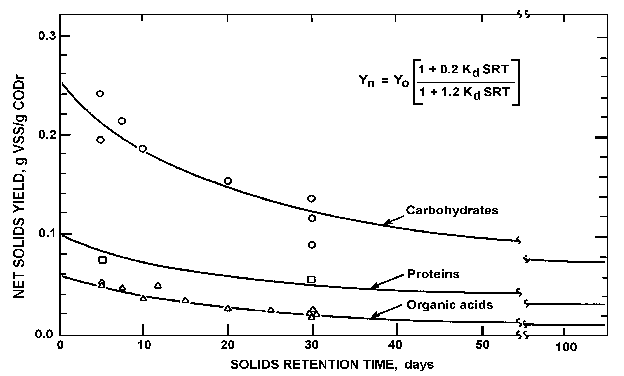
SRT = total active biomass concentration / net growth of active biomass
The first task is to get reasonably accurate measures of waste flows and COD/solids loads and other critical parameters such as TKN and sulfates. Then one can work toward process selection and reactor sizing. Other treatment objectives such as nitrogen removal need to be factored into the process selection and sizing. Without treatability testing, it usually is not beneficial to use complex modeling so a simple, educated spreadsheet approach to reactor sizing and estimating of biogas production is OK for starters.
ABATTOIRS
Abattoirs are well suited targets to low-rate, anaerobic process because of the usually low COD and high O&G levels. It may be also possible to design as competitive, higher rate systems. As with most every anaerobic approach, process temperature is key. One will want to avoid seeing an anaerobic treatment plant for wastewaters that contain grease, such as meat processing, milk, cheese, etc., operate at less than 32C. If client or engineers insist, they have to deal with the consequences of designing and operating at lower temperatures. First , a larger reactors. Second, most of the grease will float to the top and form a scum layer that in some cases with meat slaughtering operations has approached six ft (2 m) in depth. This scum layer is very difficult to breakup especially if the reactor is covered with a membrane type material. These problems may occur at 32C, but to a much lesser extent. Therefore stick to and maintain the higher temperature range. Below 20°C removals are simply settling, hardly any anaerobic biological process contribution.
Abattoir wastewater from fowl is particularly difficult to deal with in that it contains a lot of protein and gut waste which is high in nitrogen. The protein is slow to degrade with strong odor potential, as rotting protein tends to have. Cadaverine for example is one of the organic chemicals produced by decaying flesh that gives it the ugly smell. In warm climates, picking things like open, trickling filters or aerobic biotowers where biomass and flesh could get trapped on the media and wherein the decay odors could get passed directly to air leaving the tower, would be definitely unadvisable. Many of abattoirs in the U.S. are using oversized and relatively inexpensive oxidation ditches to process these wastewaters.
Clarifiers usually are not good options for pretreatment of slaughter-house wastes because of the stringy characteristics, the fats, and the odors. Grinders followed by screens and DAF or centrifuges usually are better.
DAIRY WASTEWATER
HAFs are not good candidates for treating dairy wastes, Because of the high FOG and high biomass yields, the media tends to plug and float. UASBs are much better if the FOG is less than about 100 mg/L. Low rate or completely mixed reactors usually are best overall.
EDIBLE OIL
CITRUS AND WET MILLING WASTE
Anaerobic treatment is the best option for both citrus and wet milling wastewaters. To a certain extent high rate configurations such as UASBs and EGSBs can be considered as well as low rate reactors. Low rate rate systems will feature design loading rates probably somewhere in the 0.5 to 1.0 kg/m3/day range, so as with high rate designs one can roughly work out the approximate volumes. Low rate systems are good for wastewaters such as thin stillage.
Corn wet milling wastewaters are ideal candidates for anaerobic treatment. Whole stillage is best treated using completely mixed reactors; thin stillage -- after solids removal -- can be treated using high rate processes. One can give preliminary reactor sizing if the general wastewater characteristics are known -- COD, TSS, VSS, TKN, etc. -- and flow rates.
In general one requires as much information as possible about the wastewater characteristics including COD, TSS, VSS, alkalinity, pH, VFAs, and temperature in the reactor. Also, a schematic diagram of the reactor would be helpful. Lemon processing wastewaters often contain limonene, which is an organic solvent and can cause damage to anaerobic granules. Any information on limonene concentration in the wastewater will be helpful.
FEEDLOTS
Feedlot wastes are treatable anaerobically, but require a process configuration that allows the owner to process high solids content.
See solids digesters section.
MANURE DIGESTION
The Germans have a lot of experience with manure digestion using large mixed reactors (we would hesitate to say completely mixed), and some high-solids digesters (usually plug-flow). Manure is digestible but management of mixing and sludge removal/disposal is of high importance.
Lagoons are not good options for treating manure or grease because of inability to mix and remove waste solids. So they fill up quickly and if covers are used, the grease floats and accumulates beneath the cover with little or no digestion. Nevertheless, some industries use lagoons for treating slaughterhouse wastes throughout the world with frequent cleanout and cover replacement.
MORE ON SOLIDS AND MANURE DIGESTERS
MOISTURE CONTENT
This parameter usually does not affect anaerobic treatability unless it is above 95%, in which case the solids would be 5% or 50,000 mg/L TSS. If the moisture content is less than 50%, the solids may be too heavy to mix.
ASHES
This parameter represents salts or grit. High salt content (TDS > 15,000 mg/L) can inhibit methane production. Manure can have high ash content due to dirt and mud. Grease wastes usually are low in ash.
VOLATILES
Most volatiles of concern with anaerobic treatment are the volatile organics such as gasoline, hexane, toluene, etc. These compounds usually are not toxic but also are not biodegradable in anaerobic reactors, but can cause dispersion of solids.
CALORIFIC CONTENT
Grease has a COD/weight ratio around 3:1, so grease presents a high COD loading potential and at temperature below 30C usually do not degrade efficiently and accumulate in anaerobic reactors as floating grease balls or rise to the surface of the digester and forms scum layers. This is especially a problem with covered anaerobic lagoons.
Manures usually have low calorific content because of the straw, hair, and dirt. At high loading rates, the ammonia nitrogen can be sufficiently high to inhibit methane production. We usually try to keep ammonia-N below 1500 mg/L for safe operation.
DUMPING WAS INTO ANAEROBIC DIGESTERS
One thing we recommend strongly is that you should NOT put waste activated sludge back anaerobic digesters unless it has been specifically designed for solids such as classical sludge digesters.. This tends to fill the digester with inert solids and over time will fill the lagoon/basin or tank with inert solids or dilute the activity of the anaerobic biomass.
TANNERIES
Tannery wastewaters are very difficult to treat anaerobically because of the salts, acids and chemicals used for processing the hides. One further needs to know the type of tanning process -- vegetable, chrome, etc. -- and the general characteristics -- COD, VSS etc. If the wastewater is treatable, one would expect one will need to use DAF to remove the solids before anaerobic treatment. A low rate type reactor could be OK, but probably design COD loading rate should be close to 1.0 kg/m3/day.
ANAEROBIC TREATMENT AND HYDROGEN SULFIDE CONTROL
One possible alternative to deal with hydrogen sulfide is to add ferric or ferrous chloride to the influent to the anaerobic reactor to tie up the sulfide as ferrous sulfide. This alternative works well but will increase the density of the sludge so may not be best for UASB or EGSB reactors. It takes about 1.1 kg of Fe per kg of sulfide if no competing reactions are present. Another alternative is to strip the sulfide from the gas stream using a caustic scrubber at pH > 9. This method would require a spray tower, a caustic (NaOH or KOH) feeder, and a sump for recycling the scrubber water. This method works well but can require substantial amounts of caustic because some carbon dioxide also will be scrubbed as sodium or potassium bicarbonate. Biofilters work well for vent gases but would be very large and expensive for biogas streams. The Hiperion and similar processes provided by a number of vendors convert the hydrogen sulfide to elemental sulfur, but can be quite expensive. Activated carbon works well but probably will be very expensive.
CALCULATION OF SRT (SOLIDS RETENTION TIME)
For the purpose of rough calculations we can, whatever the units used, and using say COD as constituent, combine these two formulas:
Yn = Yo * ( 1 + 0.2 * Kd * SRT) / ( 1 + 1.2 * Kd * SRT)
Yn = bugs in tank * 100 / ( SRT * kgCOD/day * COD removal points)
Thus we have
bugs in tank * 100 / ( SRT * kgCOD/day * COD removal points) = Yo * ( 1 + 0.2 * Kd * SRT) / ( 1 + 1.2 * Kd * SRT)
Solving for one of the SRT we get the coveted iteration formula:
SRT = bugs in tank * 100 * ( 1 + 1.2 * Kd * SRT) / ( kgCOD/day * COD removal points * Yo * ( 1 + 0.2 * Kd * SRT) )
From now on it's just a matter of allowing Excel to perform circular reference iterations (you may have to enable this setting in your Excel version).
For those unfamiliar with iterative methods (a numerical analysis classic) one way to find a root of an equation is to solve for the variable and give iterative methods a try.
Were we to find a root for say
a * x^2 + b * x = (a * x + b) * x = 0
One possible iteration formula to try could be solving for x as follows:
x = 1 / (a * x + b)
While it may seem laughable to do it for this case the truth is that it works great for the not so immediate cases. With minor tweaks it can be used for UASBs, HAFs, BVFs, BNR TFs of all sorts.
INLET DISTRIBUTION AND RANS LATERALS FOR BULK VOLUME FERMENTERs
The inlet and RANS laterals should be placed on blocks -- concrete should be OK -- to which the laterals should be fastened. They should be heavy enough to avoid flotation of the pipe. Vertical concrete walls around the top of the basin are used to attach the cover.
Do bulk volume fermenters use a double membrane gas holder?
That's your decision. There are several options for lagoon covers. Some are double layer; others are single. We personally prefer the type of cover that floats on the surface with gas collection at the sides and ends. This type of cover avoids wind damage. We have actual plant records showings some problems with covers that allow gas collection under the cover.
The gas is channeled to the perimeter via lateral floats. The floats create a high point and the rain trench creates a low point. A micro gradient is formed between the two structures. Rainwater flows downward into the trench and gas bubbles formed under the cover travel along the gradient to the high point where they are pulled to perimeter piping via negative pressure. The perimeter piping terminates at a draw-off pipe (preferably through the slope and not the cover) to a flare or genset.
In order to obtain more information and/or request courtesy capacity plannings or case assessments, please send an e-mail to Martin Balestie <answers@engineeringfundamentals.com> and/or/cc Martin Balestie <balestie@umich.edu>. It is recommended to include a brief initial description of the case, ideally no more than one page, or project in progress / under study. The possibility of receiving and handling individual technical consultations has been foreseen but are limited as per availability. Alternatively make contact via sms/telephone +1 917 300 3024.