BULK VOLUME FERMENTERS: FUNDAMENTALS
Bulk volume fermenters, typically designed low-rate, say at food-to-microorganism (F/M) ratios between 0.1 and 01.5 g COD/g VSS/day. are basically excavated basins with insulated covers and liners. Wastewater is evenly distributed by way of straight perforated pipes throughout the first or biodegradation stage chamber and which occupies about 40% of the total volume, and then proceeds to the second or clarification stage which allows solids to settle for recycle and/or wasting.
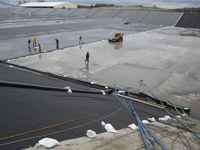
Anaerobic treatment is a biological process that utilizes a mixed culture of bacteria in the absence of free oxygen to remove organic matter that is present in wastewater. The overall process yields a useful byproduct in the form of biogas, primarily methane (CH4) and carbon dioxide (CO2)). This unique feature means that much of the available energy in the wastewater is converted to a gaseous form, resulting in very little energy left over for new cell growth.
BENEFITS
In a nutshell, three significant benefits are associated with this process, namely the production of biogas energy, much less biosolids waste and low energy requirement for the treatment process, in addition to these benefits:
less nutrients required;
system can be shut down for extended periods without serious deterioration; and can handle organic shock loads effectively.
DRAWBACKS
As with any process, however, anaerobic treatment does have certain drawbacks, including the following:
anaerobic treatment alone cannot achieve surface water discharge quality, i.e. post-treatment is required
reduced sulfur compounds are produced, which need to be properly addressed in terms of corrosion, odor, and safety; and
longer start-up period.
Several different anaerobic technologies are available in the marketplace. The best technology in one case may not be the best in another. Wastewater characteristics affect the success or failure of specific processes. Fixed-media processes seem to be most suitable for treating low-yield waste constituents, while suspended-growth reactors are most suitable for treating high-yield wastes that readily produce granules. However, with proper selection of organic loading rate and operating conditions, each system can treat almost any type of wastewater but possibly will not perform optimally. Unless previous experience is available with treating a specific wastewater, treatability tests are recommended highly.
BIOLOGICAL PRETREATMENT IN INDUSTRIAL APPLICATIONS
Without a doubt, incorporating an anaerobic pretreatment, frequently implemented as a simple anaerobic lagoon, is likely to be extremely beneficial in a large number of industrial wastewater processes, such as those from tanneries, slaughterhouses, confined animal husbandry, and poultry processing plants. For both the removal of high organic loads and the retention of suspended solids and fats, the anaerobic lagoon or the low-rate reactor are extremely useful configurations for minimizing any subsequent aerobic biological process. Obviously, depending on the nature of each effluent, the organic load can be significantly reduced, for example, from inlet BOD5 values exceeding 20,000 mg/L to outlet values slightly above 2,000 mg/L. Significant reductions in suspended solids levels are expected, whether desirable or not. It is important to remember that the anaerobic digester must be filled with biodegradable materials and not become a sand deposit. As can be seen in numerous examples of confined rearing, anaerobic lagoons can do little to remove ammonia nitrogen, in some cases with values exceeding 2,500–2,600 mg/L. In these cases, the oxygen supply for nitrification can be sized several times (e.g., 4x–5x) compared to the system size if only BOD5 were considered in the design. For example, a plant treating both BOD5 and TKN would require around 1,100 HP, while the demand for BOD5 could be approximately 220 HP. The importance of this observation is that any design based exclusively on BOD5 values can have its performance severely distorted due to oxygen sequestration by nitrifying agents, naively intended for BOD5 removal. Therefore, regardless of any potential accommodating attitude toward the authorities, every responsible designer must require and consider sampling of TKN and P.
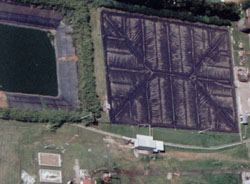 Unlike series or partially mixed lagoons, generally only a single anaerobic lagoon is effective; that is, little is gained by having two anaerobic lagoons in series. Ideally, the natural formation of a crust or surface layer (fats, solids, fiber) should be preferred, but in certain cases, synthetic covers, such as geomembranes, must be used. It is important to reiterate that the objective of this unit process is digestion, so irregularities in the feed, such as excess fat, solids, calcium, sulfates, or ammonia nitrogen, must be avoided. The example of the impact on the discharge from a plant without prior separation of fats and oils is particularly illustrative .
As with the digestion of municipal primary sludge, energy recovery systems using combustion of the generated gas are frequently employed. If these systems are not practical, the use of burners is highly recommended, at the very least.
From a numerical calculation standpoint, the classic BOD5 removal formula can be used, although it is imperfect in numerous aspects (definition, process, yields) . This formula is applied to a series of partially mixed lagoons, using k = 0.05 l/day, 20°C . It is important to remember that the exposed surface area to lagoon volume ratio should be minimized as much as possible to reduce heat loss/dissipation. The principles of anaerobic treatment, i.e., the mesophilic range of 30-38°C, are applicable. It will be extremely helpful to compare the sizing of this relatively historical approach with the data set of the following calculation, using contemporary design criteria and mechanisms:
In order to obtain more information and/or request courtesy capacity plannings or case assessments, please send an e-mail to Martin Balestie <answers@engineeringfundamentals.com> and/or/cc Martin Balestie <balestie@umich.edu>. It is recommended to include a brief initial description of the case, ideally no more than one page, or project in progress / under study. The possibility of receiving and handling individual technical consultations has been foreseen but are limited as per availability. Alternatively make contact via sms/telephone +1 917 300 3024.