Screening - Grid and Mesh/Sieve Systems
We can probably divide these two unitary processes based on the opening used.
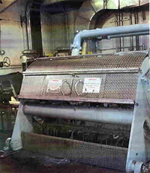 In the case of screen systems , generally reserved for separating coarser solids, these are simply profiles, bars, or flat bars (e.g., 3/8" x 2") arranged parallel to each other on a frame. The angle of the screen assembly typically ranges from 0 to 30 degrees for self-cleaning systems and from 30 to 45 degrees for manually cleaned systems. They are frequently used before screens or filters with smaller openings. The most common openings range from just over half a centimeter to just over seven centimeters. However, there are numerous variations, and as with screen or sieve systems, efficiencies vary considerably.
Within mesh or sieve systems , it is characteristic to distinguish systems of at least three (3) different types:
1. static systems or sieves, i.e., "sidehill" type
2. rotary sieve systems or screens, a variant of the above for effluents with special characteristics that may have a tendency to clog the meshes (e.g., gelatinous, oily or highly adhesive formations)
3. vibratory systems
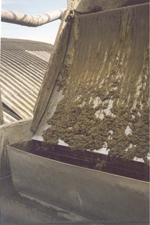 In the case of static screening systems/sidehills , the effluent is typically discharged into an upper channel that overflows onto a concave or inclined surface with a parabolic or semi-parabolic profile (the screen itself), which acts as the separation element. The solids retained on the upper surface are then collected as they descend into a second channel, which often contains a screw conveyor. The liquid that drains through the screen is collected in a hopper at the bottom. The openings can vary between 0.25 mm and 2.5 mm, with 0.5 mm probably being the most commonly specified value when information is lacking. Generally, the best selection results from a test protocol using two or three openings. This allows for greater individualization, for example, selecting 0.25 mm for a biological sludge thickening process, 1 mm for tannery effluent, or 0.35 mm for certain fish processing industries. Unfortunately, in certain cases, such as in livestock pens and slaughterhouse yards, and in rumen and manure, the capture percentage is variable, depending on the animals' diet. This makes the choice of a specific measurement somewhat arbitrary. A common application range is for capturing solids in the 100 to 1500 micron category. Furthermore, a well-chosen equipment selection can increase the solids content from 0.5–1% to 3–4%, thus optimizing any subsequent processing of the captured material (e.g., concentration using a screw press).
As always, apologies to readers using the SI system, in the case of static sidehill screens , flow rates can range from 36 to 280 gpm per linear ft (width) of mesh in clean water conditions (i.e., without specific de-rating for the effluent type). In many cases, such as in the poultry, fishing, and meat industries, de-rating can reach 55-60% or more. Given a clean water value, e.g., 100% for a given opening (e.g., 0.5 mm), the flow rate to be circulated under these conditions should be 40-45% of the corresponding clean water flow. In many cases, this translates to between 50 and 150 gpm per linear ft (width) of mesh . Another selection/sizing criterion may indicate between 2 and 10 gpm/sq. ft. The ideal procedure for determining a sieve's capacity or selecting an appropriate unit preferably involves selecting the equipment and verifying its operation with numerical estimates using the efficiency table, not just for the sieve itself, but for the entire system. We may run the risk of overloading and subsequent clogging of the sieve/mesh and liquid overflow. It is also possible to use a protocol for conducting capture tests and selecting the "optimal" opening size. USEFUL NOTE: How can you tell if a sieve is working correctly? There should be clear drainage in the upper third of the slotted/grid chute and a "smooth" flow of material in the lower two-thirds.
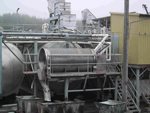 The operation of rotary screen systems or screens is similar, with internal feeding being the most common specification. Rotary equipment is generally used in situations where the effluent has properties that could clog or compromise the screen's performance as a filter element. The filter element can be metallic, primarily stainless steel wire formed into sheets or cylindrical surfaces. Screens with filter elements made of engineering plastics are also available.
As a rough guide for preliminary sizing/selection of rotary systems, a hydraulic loading criterion can be applied for solids contents up to 0.05% (500 mg/L), beyond which a mass loading criterion is recommended. In the case of static screens , sizing based on hydraulic loading (e.g., gpm per ft) is acceptable up to 2% (20,000 mg/L), beyond which mass sizing is used.
Vibrating screen systems typically require less filtering surface area and can have lower initial costs. Additionally, the retained material is usually drier because the system is self-cleaning without the use of the traditional spray washers found in older systems.
EXAMPLE OF APPLICATIONS AND GUIDELINES FOR SIEVES IN MEAT/POULTRY PROCESSING INDUSTRIES
As a common illustration, the aperture size in the meat industry, for example, typically ranges from 0.51 mm to 0.76 mm. In the poultry industry specifically, the recommended size is 0.51 mm (0.02"). Generally speaking, each case is unique, and all requirements should be carefully examined to determine the best possible solution. In some cases, depending on the application and the type of solids, larger apertures, such as 1.02 mm (0.04"), may be selected. Screens are frequently equipped with a jet cleaning system that removes any particles that may have remained on the screening surface.
Equalization or compensating tanks
The equalization tank is probably one of the most important unit processes in the plant, despite its apparent simplicity. The simplicity of the required equipment often makes us forget its tremendously valuable contributions:
To balance and moderate both the hydraulic and organic load in order to prevent or minimize the impact of excesses on the biological system; a constant flow does not necessarily translate into a constant (organic) load, although we would all like life to be easier!
control and adjustment of favorable pH
allow or administer feed to the treatment plant even when production is not operational (weekends, shutdown times);
prevention, attenuation, dilution or inhibition of the arrival of toxic material to the biological process;
homogenization of constituents (deliberately)
In many unit processes, sizing an equalization or intermediate storage tank results in a significant reduction in the dimensions of the required equipment, e.g., DAF, BFP, among others; an 8-hour block discharge can be divided into 24 hours of continuous operation.
For the purpose of implementing the mixing of the constituents, as well as preventing deposition in the tanks, it is common to use agitators or mixers of different types, from mechanical aerators (power densities between 15 and 20 HP per mg of tank), diffusers (e.g. 0.12 cfm or more per sq.ft. of bottom) and turbine-type mixers.
Flotation Cells - Recovery and/or Removal of Greasy and/or Oily Material
There are multiple reasons to emphasize the incorporation of mechanisms or processes that retain or separate fatty/oily material, whether in emulsion or free, among others:
Frequently, much of the retained or recovered material may have some market value, e.g., feed cover, soapmaking, fiber for reprocessing, recovered hydrocarbons;
As an immediate result of the previous point, in addition to not configuring greater expenditures, it allows managing the alternative of smaller subsequent treatment trains, e.g. if we can retain 35% of BOD5 in pretreatment, theoretically we could reduce the size of the biological, a decision that the consultant will evaluate;
It is extremely likely that, if a high percentage of certain substances are not retained, they will cause considerable harm in subsequent biological processes, either by reducing tank volume (-> shorter detention time than calculated) or by directly interfering with the interaction between the different constituents.
Beyond simple grease traps and skimmer -type mechanisms (which primarily remove non-solid adhering material), we can note two major alternatives:
Classical separation primarily for free fats (e.g., particle diameters greater than 5-10 µm), e.g., API tanks, and
resolution or breaking of possible emulsions and assistance/removal using flotation cells (DAFs).
In refineries and port terminals, it is common to find sequences of API and DAF tanks. The latter, dissolved air flotation cells, are classic unit processes in a variety of industries, notably poultry, fishing, dairy, slaughterhouses/meatpacking plants, pig farms, fruit and vegetable processing, and paper mills. Similar equipment is used in bilge water/naval base discharge treatment plants and similar effluents.
In general terms, and similar to opening a bottle of soda, the operation of flotation cells is based on three fundamental principles: Henry's law for gases with low solubility, the nucleus theory , and Stokes' law. According to Henry's law , at a constant temperature, it is possible to dissolve significantly more air (e.g., five times more) by subjecting the liquid to pressures greater than, say, atmospheric pressure. When the pressurized liquid is released, the air leaves the dissolved state and forms bubbles that immediately tend to rise. The nucleus theory states that these bubbles will adhere to the suspended particles, creating a kind of "lifeline" that pushes them to the surface. The resulting agglomeration, formed by the mixture of air molecules with the particles of interest, is less dense than the surrounding liquid, and through flotation, it separates material that would otherwise remain suspended.
The geometry of flotation cells can be either rectangular or circular. The piston-like flow in rectangular cells is hydraulically more stable than the radial flow distribution in cylindrical tanks. Additionally, the flow to be treated in rectangular cells can enter at lower velocities due to the larger cross-sectional area (full width and depth), minimizing the possibility of unwanted bypasses. Furthermore, their greater tolerance to changes in flow rate and temperature minimizes potential disturbances. Therefore, higher hydraulic loading rates are possible. It is possible to operate at lower chain velocities while still achieving a high degree of surface recovery, with less disturbance from floating materials, allowing for higher concentrations. Additionally, the amount of water in the sludge can be more easily controlled.
We have received requests for quotes on disc or tubular diffusers for implementing flotation cells, especially for use as homogenizing or equalizing tanks, e.g., in industrial ice cream factories . Beyond the benefit of homogenization, it is incorrect to interchange the unit processes. The flotation cell (DAF) works by incorporating pressurized air into the flow to be treated and releasing it into the mixture from the bottom. The air leaves the liquid phase upon returning to atmospheric pressure and, as it rises, carries the "colloidal" or intermediate/agglomerated particles upwards. The function of an air diffuser, fully integrated into a bottom-feed pneumatic circuit, is simply to maintain, e.g., 2 mg/L of oxygen in the tanks. It is very likely that using this latter "method" will only emulsify the constituents to be captured by this "flotation" (e.g., fat/oil), probably complicating our product recovery problem. Additionally, while the bubble diameter of aeration diffusers can vary between 1 and 3 mm, the most effective bubble diameters of flotation cells are between 30-50 and 100-120 microns for DAF type cells and 1000 microns for induced or dispersed flotation cells (e.g., used in oil extraction fields).
Pressurization can be performed in three ways, depending on the problem's characteristics: pressurization of the entire flow , pressurization of a fraction of the flow ( partial pressurization ), and pressurization of the recycle or return flow. The latter offers the significant advantage of eliminating unintentional or unwanted emulsification caused by pumping and turbulence during pressurization. The hydraulic loading rate of a DAF ranges from 1.5 to 3.5 gpm/sq.ft., with dwell times between 15 and 30 minutes. The use of tubular flocculators and plate settlers within the unit can dramatically reduce its compact size.
Flotation cells are favored unit processes in countless industrial contexts: oil refineries, terminals and naval bases, machine shops/machining yards, agribusinesses (e.g., vegetable oils), meat industries (poultry, slaughterhouses/meatpacking plants, fish processing, charcuterie), the dairy industry, industrial baking, among others. Other highly relevant industries include the paper sector and fruit and vegetable packing plants. The capture of algae is incredibly successful, as is its use in thickening (e.g., 4–6%) or concentrating secondary clarifier sludge—the latter being particularly noted by Eckenfelder. Preliminary/illustrative calculation for a small oil refinery.
The cells can recover high percentages of fats and oils (e.g., 97%), total solids (e.g., 96%), and consequently a significant fraction of BOD5. It is not possible to intercept sBOD5, ammonia, or anything "soluble," but the contribution of these units, especially when used in tandem (the first for product recovery, the second for assisted removal and disposal), is unequivocal and in certain cases highly recommended. TSS levels above 200 mg/L and fat/oil levels above 100 mg/L can significantly disrupt the subsequent biological treatment stages. See an illustrative real-life example .
EXAMPLE OF APPLICATIONS AND GUIDELINES FOR DISSOLVED AIR FLOTATION CELLS IN MEAT/POULTRY PROCESSING INDUSTRIES
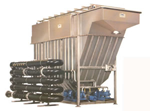 Contemporary design flotation cells (DAFs) have very small floor areas thanks to the installation of plates. Thus, a process or machine operating with a solids loading of 11.2 kg/h/m² (2.3 lb/sq ft/hr) can easily reach 70 kg/h/m² (15 lb/hr/sq ft) in certain types of industrial applications without the risk of collapse. Upon collision with an angled plate, lighter solids are ejected upwards, while heavier particles slide downwards for collection and removal.
The Poor Man's Centrifuges
We would like to conclude our comments on these arbitrarily chosen "technologies" (actually unit processes that help reduce the use of chemical aids) with a separation process that is rarely considered, despite its numerous advantages and very few drawbacks. Hydrocyclones, or hydraulic cyclones, a kind of "poor man's centrifuge," are excellent solid/liquid and liquid/liquid separators. A favorite tool, especially in the mining sector, hydrocyclones require no chemical aids, have no moving parts, employ well-established technologies, have an exceptional lifespan, and consume no energy beyond the pump that feeds them. Even though their use is extremely widespread—e.g., mining, oil production, petrochemical plants, food processing, the pharmaceutical industry, grit removal—these extremely "low-profile" pieces of equipment contribute dramatically to protecting the rest of the installation (downstream equipment, pumps, piping) as well as fulfilling their valuable role in separating valuable components. Hydrocyclone separation typically handles particulate matter with diameters between 37 and 210 microns, although in special cases it can achieve the separation of solids with diameters close to 3-5 microns.
In order to obtain more information and/or request courtesy capacity plannings or case assessments, please send an e-mail to Martin Balestie <answers@engineeringfundamentals.com> and/or/cc Martin Balestie <balestie@umich.edu>. It is recommended to include a brief initial description of the case, ideally no more than one page, or project in progress / under study. The possibility of receiving and handling individual technical consultations has been foreseen but are limited as per availability. Alternatively make contact via sms/telephone +1 917 300 3024.