Bulk volume fermenters were/are meant to handle soluble constituents. Thus someone has to process whatever solids are involved, be it float or solids from DAF, primary or waste sludge, whatever. Do not feed or dump solids into bulk volume fermenters - it's not their intended role.
So lets talk about systems specifically designed to handle that type of load (particulate matter). It is sometimes very difficult to limit a presentation or the scope of a definition without somehow harming a particular discipline. In preparing the content of this primer, we have had to make some arbitrary decisions and will likely perpetuate only some of the possible meanings. In many contexts, there are even other terms used to refer to essentially the same unitary process.
Within the framework of our introductory series, we will initially limit our coverage to the following contexts:
instances of municipal sludge digesters, whether aerobic or anaerobic
Industrial applications, i.e. instances of "rustic" digesters such as anaerobic lagoons, that is, fundamentally as biological pretreatment
instances of "rustic" digesters used in confined rearing establishments
Technically, we should be including historical variants such as Imhoff tanks, recently revalued especially in decentralized treatment, or established technologies like UASBs and anaerobic filters, hybrid or not. For organizational reasons, we have preferred to present the material separately, even though we all know that both the microbiological aspects and the concepts involved, e.g., mixing criteria (3), energy recovery, system components, will be present in some way in all cases, although obviously with different characteristics, fundamentally retention times involved, operating temperatures, and volumetric organic loading (m3COD/day per m3 reactor).
The reason for initially focusing on only the three contexts above is that they somehow signify digestion processes with "different" objectives, namely:
In the case of municipal sludge digesters, the objective pursued is fundamentally to reduce/inertize cell mass;
In the case of "rustic" digesters such as anaerobic lagoons, artificial or natural, the objective is to develop biomasses that assimilate soluble organic material, leading to the generation of methane and carbon dioxide.
In the case of "rustic" digesters used in livestock farms, we are considering accepting "effluents" into the treatment process with relatively high levels of suspended solids, e.g., 10%, 11%, or 13%. For example, a general design guideline for more sophisticated anaerobic processes would routinely recommend that this value (suspended solids) not exceed, say, 10% of the corresponding COD value.
Someone could even propose a dry landfill cell as an immense anaerobic digester, and it should indeed warrant such a comment. Similarly, a proponent of a wet cell would be entitled to use the label, as would the manufacturer of a gas-phase biofilter.
With the above caveats, we will then proceed to only comment on the classic context of municipal sludge digestion in its two variants, the unit process of biological pretreatment implemented in countless industries with variants of anaerobic lagoons and the "rustic" reactors used in confined breeding environments.
BASIC ELEMENTS OF AN ANAEROBIC SOLIDS DIGESTER SYSTEM
With varying degrees of sophistication, virtually every digestive process will incorporate all or some of the following items,
some type of prior mechanical separation;
some type of heating, whether natural or artificial
some mixing mechanism, whether hydraulic, pneumatic, thermal, or mechanical
some type of energy recovery (heat exchanger, boiler) or failing that, a burner probably capable of working with another fuel
MUNICIPAL SLUDGE DIGESTERS
Within the context of our environmental series, we can classically distinguish between aerobic and anaerobic digesters. Both unit processes have been employed in countless contexts with great success.
Aerobic digesters were specifically developed for processing sludge (excess biomass) from activated sludge plants without primary clarification. While this configuration is extremely popular, and particularly acceptable in a wide range of plants, the characteristics of the excess sludge generated, typically with concentrations between 0.5 and 2% (if we're lucky!), recommend its subsequent digestion, ideally preceded by a concentration stage, e.g., using thickeners or flotation cells.
In a way, anaerobic digesters, in their various forms and configurations, have found perhaps a greater number of applications in both conventional sanitary engineering and industrial and agro-industrial environments. For this reason, this first edition of digestores.net includes their coverage proportionally, i.e., it highlights applications of anaerobic digesters.
In reality, the first wastewater treatment systems were based on variations of anaerobic treatment, such as Imhoff tanks , which classically consisted of an initial settling stage followed by digestion in the lower cell. These "technologies," which include the domestic septic tank, while excellent in terms of solids retention, were gradually abandoned as the requirements for wastewater discharge increased, specifically lower values for the dissolved BOD fraction. This deficiency led to the progressive implementation of aerobic systems, such as activated sludge plants, relegating the role of anaerobic digesters to processing the primary sludge and the role of aerobic digesters to stabilizing and reducing the cell mass resulting from the biological process.
However, and selectively, anaerobic digesters have evolved to unequivocally predominate in certain contexts such as anaerobic digestion of primary clarifier sludge, biological pretreatment in industrial applications, selective treatment of hazardous constituents, accelerators of the degradation process in landfill cells, and agro-industrial applications.
INDUSTRIAL APPLICATIONS
The reason for referring to " biological pretreatment in industrial applications " is simply to emphasize that while an anaerobic digester, whether implemented using an anaerobic lagoon or a sophisticated reactor, does not substantially remove nitrogen, it's important to remember that to convert ammonia nitrogen to nitrites and then nitrates, oxygen must be supplied. Therefore, in many industrial applications, aerobic post-treatment is necessary, and its actual scale is often surprising . Just calculate the horsepower (HP) required for any confined animal facility, such as pigs or cattle, to see the impact.
It is interesting to note that the values of total nitrogen, ammonia nitrogen, nitrites, nitrates and total phosphorus show practically no variations in the acetic and methanogenic stages of a landfill.
MICROBIOLOGICAL ASPECTS
The details of the microbiological aspects involved in anaerobic processes can be found in the classic work by Wilkie & Colleran. Organic compounds, e.g., proteins, fats, polysaccharides, are converted into simpler compounds, monomers and oligomers (e.g., sugars, amino acids, etc.), which are then converted into organic acids and hydrogen. In the final stage, methane and carbon dioxide are generated. Treatability studies can inform design programs that quickly allow for the evaluation of treatment alternatives for different types of wastewater.
MUNICIPAL SLUDGE DIGESTION
Perhaps the most familiar context for anaerobic digesters is the digestion of municipal sludge from primary sedimentation tanks. Broadly speaking, Imhoff tank systems for smaller plants, followed by primary clarification and then one- or two-stage anaerobic digestion, are the most common sludge management configurations.
Imhoff tanks are essentially structures where the clarifier and digester share the same unit. History tells us that these systems, excellent mechanisms for removing suspended solids, proved deficient in removing dissolved organic matter, leading to their gradual phasing out. Fortunately, a better contemporary understanding of both their competitive advantages and limitations has resulted in their recent reevaluation, especially in decentralized treatment systems.
At a second level of possible wastewater treatment plant configurations, e.g., sewage, are those that involve the physical separation of these unit processes by assigning them to separate tanks, e.g., primary clarifiers followed by anaerobic digestion in a single stage. Usually reserved for smaller-scale applications, these systems require that the classic operations of digestion, thickening, storage of digested sludge, and supernatant formation be carried out in a single vessel. Frequently heated by external heat exchangers, it is important to note that practically only 50% of the reactor volume is "biologically active" due to characteristic stratification. They are typically designed with volumetric loading rates of 0.03 to 0.10 lb/day per cubic meter (0.5–1.6 kg/day per cubic meter) .
The floating cover allows for sludge feeding and supernatant recirculation (at the beginning of the plant) during operation. Digested sludge is periodically purged from the bottom and disposed of according to the subsequent unit process, i.e., mechanical dewatering or drying beds.
In larger facilities, anaerobic digestion is frequently used in two separate tanks . The first tank is specifically designed for the actual digestion process (heated and mixed according to a specific criterion), while the second compartment is primarily used for thickening, storing the digested sludge, and removing the supernatant. This second tank is not necessarily heated and often has a floating cover or enclosure above the variable liquid level. However, it is common to design identical tanks so that their roles can be interchanged. Similar to a single-stage digester, sizing can be based on volumetric loading rates of solids between 0.10 and 0.30 lb/day per cubic meter (1.6–4.8 kg/day per cubic meter).
The numerical example we include, for a hypothetical population of just over 100,000 inhabitants, illustrates a configuration of two primary clarifiers with sludge treated by a two-stage anaerobic digestion system. For guidance, the calculation includes clarifier diameters, torques for the central drives, as well as heating requirements and an energy recovery scheme.
| EXAMPLE OF A MUNICIPAL WASTEWATER TREATMENT PLANT FOR 100,000 INHABITANTS | ||||||||||||
| flow | 37850 | m3/day | 10.00 | mgd | surface rate (gpd/sq.ft.) | 800 | ||||||
| Ssin | 235 | mg/L | 0.0235 | %H.H | two (2) clarifiers, each | 89.2 | ft diameter | 27.20 | m | |||
| % settleable | 60 | % | 141 | mg/L | will sink | 19895.0 | ft lb torque | |||||
| 94 | mg/L | will go through | ||||||||||
| SS underflow | as % | underflow flow to digester | ||||||||||
| lb/day solids to anaerobic digester | 11745.3 | lb/day | 52000 | mg/L | 5.2 | % | 102.6 | m3/day | ||||
| % volatile | 70 | % | 8221.7 | lb/day | ||||||||
| % destr. | 60 | % | 4933.0 | lb/day destroyed | electrical power | |||||||
| btu/h at 600 btu per cu.ft. | kW |
|||||||||||
| gas flow at 12 cu.ft. per lb solids destroyed | 2466.5 | cu.ft./h | 41.1 | CFM | 1479907.8 | 138.9 | ||||||
| gas flow at 15 cu.ft. per lb solids destroyed | 3083.1 | cu.ft./h | 51.4 | CFM | 1849884.75 | 173.6 | ||||||
| gas flow at 18 cu.ft. per lb solids destroyed | 3699.8 | cu.ft./h | 61.7 | CFM | 2219861.7 | 208.4 | ||||||
| total digester volume 0.08 lb/day VSper cu.ft. | 32% to electricity | |||||||||||
| total V = | 102771 | cu.ft. | 40% reclaimable | |||||||||
| using identical tanks for first and second stage | V = | 51386 | cu.ft. | per digester | 28% no luck | |||||||
| 1455.1 | m3 | |||||||||||
| 384435 | US gallon | |||||||||||
| sludge turnover | 20 | minutes | pumping capacity | 19221.8 | US GPM | |||||||
| sludge feed temperature | 55 | °F | 12.8 | °C | ||||||||
| digester temperature | 95 | °F | 35.0 | °C | ||||||||
| sludge feed solids | 6 | % | ||||||||||
| sludge heat required | 326258.3 | btu/h | ||||||||||
| 1ststage digester loss | 133602.8 | btu/h at | 2600 | btu/h per 1,000 cu.ft. | ||||||||
| plus | 133602.8 | btu/h | 100 | % additional for uninsulated roof/wall/bottom | ||||||||
| 593463.9 | btu/h | |||||||||||
| sludge heat / total heat | 55.0 | % | ||||||||||
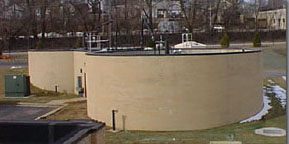 Regarding criteria and alternatives for maintaining the mixture, we can highlight three main criteria: power density, G gradient, and emptying time or "turnover." Unfortunately, each manufacturer tends to use its own criteria for evaluating mixture levels. It is important to note that the use of gradients incorporates viscosity into the evaluation. As for the implementation of the mixture, it can be carried out using mechanical, hydraulic, or pneumatic devices (with the generated gas itself). In many cases, the possibility of alternating the tanks in service is foreseen, i.e., operating the plant in one direction for a period and then switching the tanks' roles. From a construction standpoint, the cylindrical design is the most common, with liquid heights between 7.5 and 14 m, diameters between 6 and 38 m, and slopes of 1v:4h for the tank bottoms.
DIGESTORS AND CONFINED BREEDING
The separate presentation of wastewater from confined animal rearing facilities is somewhat arbitrary, characterized primarily by a high presence of suspended solids. The "best practice" would specify a greater degree of solids removal before the water enters the anaerobic process.
Broadly speaking, there are basically three configurations: covered digesters or lagoons, fully mixed digesters, and plug flow digesters.
A lagoon with a surface enclosure, such as geomembranes, is probably the most economical system, applicable to wastewater with suspended solids levels below 2%. While relatively simple, they require larger surface areas, even in warm climates. Our primary objective will be to address the soluble fractions (sCOD, sBOD). Pretreatment via screens/mesh and even a flotation cell is essential to send the captured material to a solids digester with all its corresponding requirements. Biological activity primarily anticipates the consumption of dissolved material. It should be noted that none of the digesters mentioned will handle dissolved nutrient forms, which will likely require a BNR treatment train in one of its many configurations, such as UCT.
Completely mixed digester configurations require some civil works, heating , and a mixing mechanism , such as a mechanical one. While not a hard and fast rule, they can be used for wastewater with a suspended solids content between 2 and 10%. Both this variant and the one presented below must take into account the entirely different perspective, that is, the attempt to biologically resolve particulate fractions ( temperature and mixing requirements comparable to solids digesters ).
Finally, plug flow digesters consist of a rectangular trench or channel with a cover for gas collection. In some cases, pipes are incorporated into the tanks through which hot water circulates to maintain the effluent temperature between 25 and 40°C. The solids content can vary between 11 and 13%.
In order to obtain more information and/or request courtesy capacity plannings or case assessments, please send an e-mail to Martin Balestie <answers@engineeringfundamentals.com> and/or/cc Martin Balestie <balestie@umich.edu>. It is recommended to include a brief initial description of the case, ideally no more than one page, or project in progress / under study. The possibility of receiving and handling individual technical consultations has been foreseen but are limited as per availability. Alternatively make contact via sms/telephone +1 917 300 3024.