The following steps should be followed to startup fermenter:
- 1. Obtain sufficient biomass from other anaerobic reactors. The reactors should contain around 10,000 kg of anaerobic seed culture each (as VSS) at full design COD load. Smaller amounts will require time for achieving full-load capability, but will allow to ramp up the loading rate over a two to three month period while the biomass is growing and maturing. At least 4,000 kg of anaerobic VSS is needed to startup the lagoons at approximately half the design COD load. Small amounts will take longer time for startup.
- 2. The anaerobic lagoons should be completed and ready to receive biomass at startup. The seed biomass can be stored in unlined tanks for no longer than one month before some deterioration will become evident. The tanks must be covered to avoid contacting the biomass with oxygen in the air and the tanks must be equipped with headspace gas control since some methane, carbon dioxide and possibly hydrogen sulfide can be released. Local air-quality regulations should be checked to determine the extent of containment and treatment. Load the biomass into the anaerobic lagoons under anaerobic conditions using centrifugal pumps. Care should be used to avoid mixing of air and methane gas in the headspace to avoid explosion hazards due to the oxygen in the tank during filling. Contact the biogas equipment supplier for details.
- 3. Be sure the following equipment conditions are in place and operational before adding seed culture to the anaerobic lagoons:
- The anaerobic lagoons and BNR reactors must be 100% completed with all piping and fittings in place and operational.
- All pH control equipment must be in place, with piping and valving connected and operational.
- All chemical storage and feeding equipment must be in place and operational.
- All feed pumps must be in place and operational.
- All automatic controls must be in place and operational or suitable manual options available.
- All gas handling equipment, including the flare, must be in place and operational.
- 4. Ideally, the lagoons should be filled with water only as follows:
- Fill the reactor completely to check for leaks and valve operation. Provide some small input feed to make sure the effluent collection piping works as designed.
- Test all feed pumps and chemical feed equipment to make sure it works.
- Check all pressures and to make sure the external RANS recycle system works properly.
- 5. Initiate forward flow pumping using new wastewater. The lagoons are designed for operation at a net feed-forward flow rate of 2,280 cu m/day (46 cu m/hr or 210 gal/min for each lagoon). The feed pump rate initially should be set at 50% of the design rate and ramped up to full flow in response to the pH and other operating characteristics of the lagoons
- 6. Set the RANS pump to give 100% recycle (= influent rate to each lagoon).
- 7. All pH control equipment needs to be in place with a sodium hydroxide source available for pH control. Note that only a small amount of caustic chemical (NaOH or Mg(OH)2). DO NOT USE LIME FOR pH CONTROL!!!. The pH in the effluent from the lagoons should be maintained around 7.0 but no lower than 6.8. (Note that because of the long HRT, it will take several days to see the impact of changes in caustic feed rate on effluent pH). Change the pH control feed pump slowly (ie less than 10%/day) to avoid wide swings in effluent pH. The operating periods at the indicated loading conditions are based on the assumption that the amount of biomass can handle the imposed load. If not, the rate of increase in wastewater feed rate and loading rate will decrease.
- 8. Check gas production, pH, alkalinity and VFA, and COD removal at least daily during startup (first 45 days).
- 9. After stable operation, COD removal performance and gas production rate are achieved, increase the COD loading rate by 300 kg COD/day.
- 10. Measurement methods:
Parameter |
Method description |
Frequency |
a. pH |
Use standard pH probe as installed for automatic operation or by hand-held unit for laboratory samples. |
Preferably continuous in IC reactor effluent |
|
|
|
b. COD |
Use tube method (Standard Methods method No. (Available from Hach Chemical Company, Loveland, CO; or Bioscience, Inc., Allentown, PA, and other companies) |
Minimum daily; preferably two times daily during startup |
|
|
|
c. Alkalinity |
Use Standard Methods method No. 2320B or as modified in Appendix B. |
Minimum daily; preferably two times daily during startup |
|
|
|
d. VFA |
Use total/partial alkalinity method described in Appendix B. This method gives only an approximate measure of volatile acids and should be checked periodically during startup, preferably monthly by gas chromatography to identify the distribution of various organic acids. |
Minimum daily during startup; weekly after stable operation has been achieved. |
|
|
|
e. TSS and VSS |
Use Standard Methods procedure No. |
Minimum daily during startup; weekly after stable operation has been achieved |
- Recommended analytical schedule:
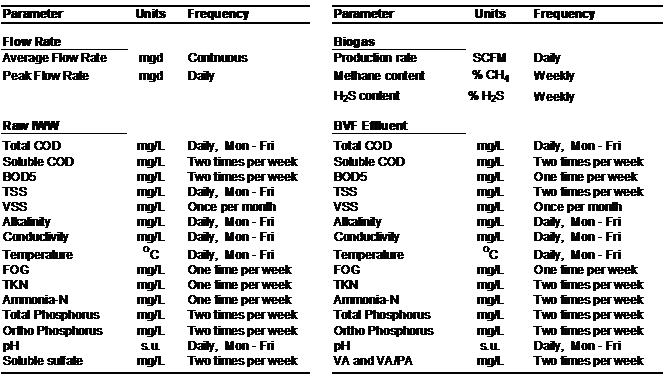 >
Appendix A
Alkalinity-pH Relationships
(James C. Young, Nov. 2008)
- Alkalinity is the acid-consuming properties of an aqueous sample and consists of the amount of acid required to decrease the pH from its ambient state to 4.3 (Standard Methods, Method 2320-B). The resulting measure usually is expressed as mg/L of Ca(CO3) equivalent or as milli-equivalents (MEQ) per liter (MEQ = mg/L alk/100).
- For samples with pH below 9.0, the carbon-dioxide, bicarbonate equilibrium is most import factor in alkalinity-pH relationships
- pH and bicarbonate alkalinity in anaerobic wastewater treatment reactors is related to the carbon dioxide content of the digester gas as shown in the figure below. Phosphates contribute to alkalinity, but usually are present in insignificant amounts.
- Alkalinity per se has no effect on anaerobic treatment as long as the pH is maintained within acceptable limits. High alkalinity will, however, help to reduce swings in pH as loading rate and/or wastewater characteristics change.
- Chemicals often used for pH/Alkalinity control:
- CaO or Ca(OH)2 (lime) Lime should not be used for control of pH in anaerobic lagoons because of the accumulation of calcium carbonate in the bottom of the lagoons.
- NaOH (Caustic soda) Caustic soda is easy to use but is more expensive than lime or magnesium hydroxide. It can lead to excessively high pH if overfed. Usually purchased at 30% to 50% solutions and fed using chemical feeders.
- Na(HCO3) (Sodium bicarbonate) Sodium bicarbonate is easy to use but is quite expensive. It will not lead to excessively high pH if overfed. Usually fed as a solution formed on site or pre-purchased solution.
- Na2(CO3) (Soda ash) Soda ash is easy to use but must be fed in a powdered or slurried form. It is more expensive than lime or magnesium hydroxide and usually more than sodium hydroxide. It will not lead to excessively high pH if overfed. Required on-site slurry preparation.
- Mg(OH)2 (Magnesium hydroxide) Next to lime in costs. Good buffer capabilities; will not cause excessively high pH if overfed. Can cause struvite formation if ammonia and phosphorus concentrations are high. Usually fed in pre-slurried form from commercial suppliers.
- NH4OH (Ammonium hydroxide) NH4OH should not be used here because of the addition of ammonia nitrogen.
- Alkalinity in anaerobic digesters often is expressed as Total Alkalinity (TA) – the acid equivalent from ambient to pH 4.3; as partial alkalinity – the acid equivalent to pH = 5.75); and as Volatile Acid alkalinity (VA) – the acid equivalent from pH 5.75 to 4.3. The VA/PA ratio often is used as a control parameter in anaerobic processes (see Appendix A for VA/PA procedure). While the VA/PA ratio ideally should be less than 0.75, most reactors can operate at much higher values as long as the pH is above 6.8.
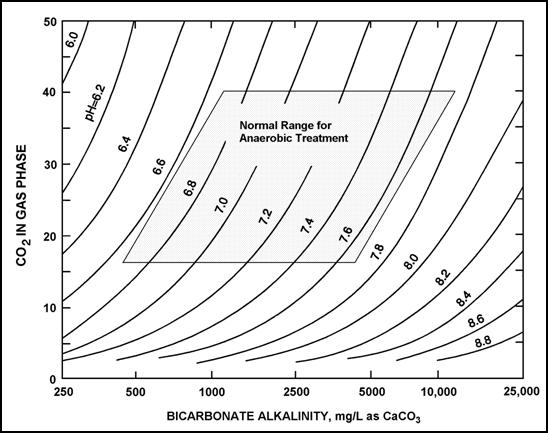
(Adapted from McCarty, 1964 and Grobicki, 1997)
PROCEDURE FOR MEASUREMENT OF VA, PA, TA
Purpose
To determine the volatile acids (VA), partial alkalinity (PA) and total alkalinity (TA) of anaerobic reactor effluent.
Equipment/Chemicals
1. Burette (25 mL)
2. Magnetic stirrer
3. pH meter (calibrated)
4. 250 mL beakers and 200 mL graduated cylinder
5. Sulfuric acid, H2SO4, 0.2 N.
Procedure
1. Do this measurement as soon as possible following collection of a fresh sample.
2. Centrifuge or settle and decant the sample to remove solids and analyze the supernatant.
3. With a graduated cylinder, transfer a 200 mL sample of supernatant into a 250 mL beaker.
4. Measure and record the initial sample pH with a calibrated (at 7.0 and 4.0) pH meter.
5. Record the initial burette reading (of the 0.2 N H2SO4) as (A).
6. Titrate the sample to pH 5.75 with the H2SO4, and record the burette reading (B).
7. Further titrate the sample to pH 4.3, and record the burette reading (C).
Calculations
1. Total Alkalinity (TA) as mg/L CaCO3
TA = [(C-A) x N x 50,000] / Sample Volume
where,
C and A are burette readings
N = normality of H2SO4
Sample volume in mL
for a 200 mL sample, this becomes: = (C-A) x N x 250
2. Partial Alkalinity (PA) as mg/L CaCO3
PA = [(B-A) x N x 50,000] / Sample Volume
for a 200 mL sample, this becomes: = (B-A) x N x 250
- Volatile Acids Alkalinity (VA)
VA = [(C-B) x N x 50,000] / Sample Volume
for a 200 mL sample, this becomes: = (C-B) x N x 250
VA, PA, TA (Continued)
Example:
Sample volume = 200 mL
A = 0.0 mL
B = 32.2 mL
C = 38.6 mL
Normality of H2SO4 = 0.2
TA = (38.6) (0.2) (250) = 1930 mg/L
PA = (32.2) (0.2) (250) = 1610 mg/L
VA = ( 6.4) (0.2) (250) = 320 mg/L
VA/PA ratio = 320/1610 = 0.2
Ideally, the VA/PA ratio should be less than 0.7 to insure against excessive pH decreases during high COD loading conditions.
In order to obtain more information and/or request courtesy capacity plannings or case assessments, please send an e-mail to Martin Balestie <answers@engineeringfundamentals.com> and/or/cc Martin Balestie <balestie@umich.edu>. It is recommended to include a brief initial description of the case, ideally no more than one page, or project in progress / under study. The possibility of receiving and handling individual technical consultations has been foreseen but are limited as per availability. Alternatively make contact via sms/telephone +1 917 300 3024.